
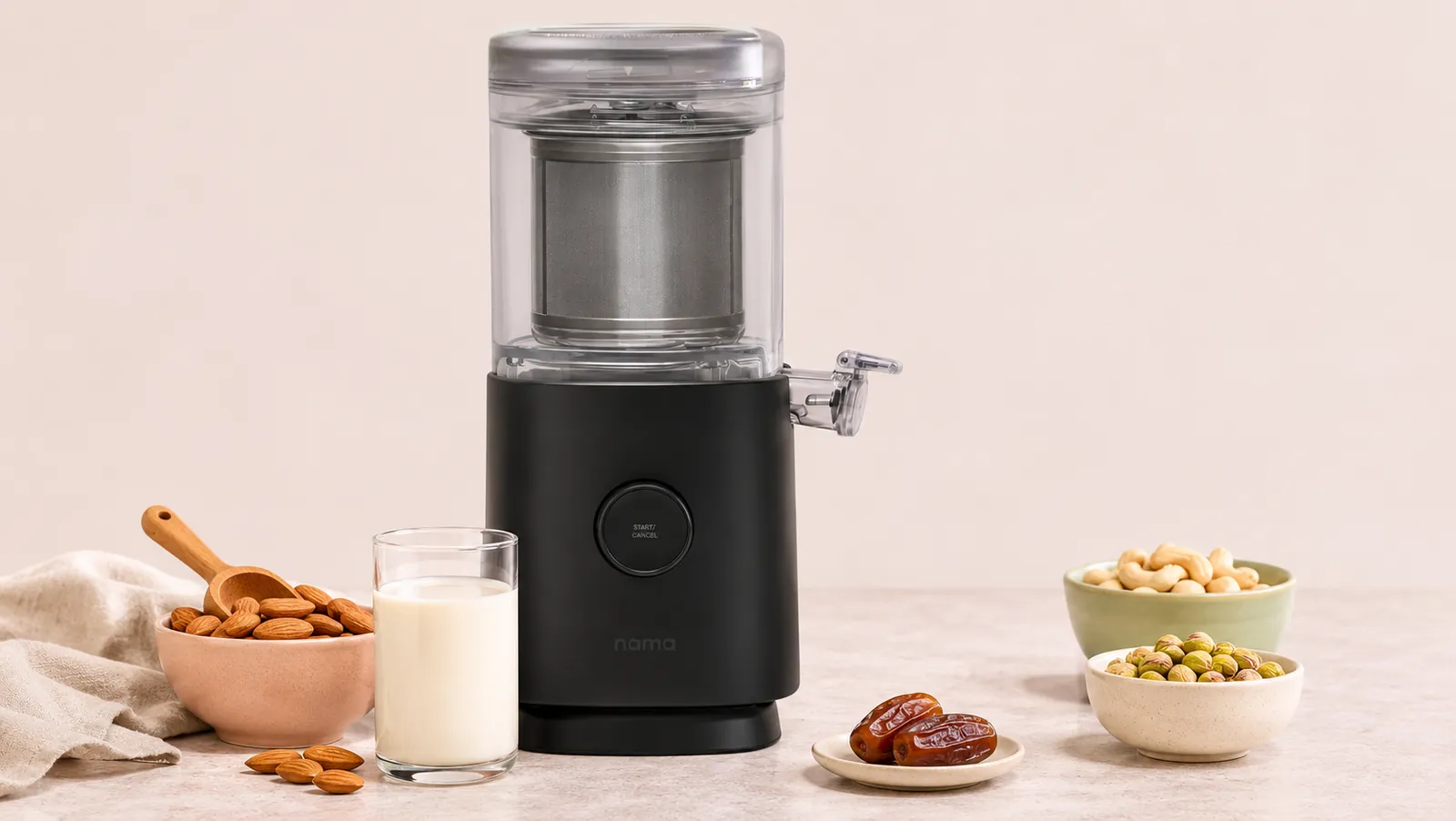
To make nut milk, blend 1 cup (140 g) of nuts with 3 to 4 cups (720 to 960 ml) of water and strain out the pulp. A milk maker like the Nama M1 blends and strains it for you in one go; with a blender, strain the milk through a nut milk bag. An optional pinch of salt and a date or two round out the flavor, and it keeps up to 3 days in the fridge.
The first glass of homemade nut milk tends to stop people
If you have ever wondered how to make nut milk that is actually creamy, why your last batch came out thin or gritty, or whether soaking really matters, this guide answers all of it. It is written for complete beginners and for people who already make a batch every few days and want it better.
Everything here is practical. Exact ratios for each nut, the method for a milk maker and for a blender, how long it keeps, what to do when something goes wrong, and what to do with the pulp. Bookmark it. Every other page on Nut Milk Recipes builds on what is here.
Why Make Your Own Nut Milk?
The first reason is taste. Fresh nut milk has a flavor that only exists for a few days after it is made. The fats in the nut are fresh, nothing has been heated, and there is nothing in the bottle except what you chose to put there.
The second reason is control. You decide the nut, the sweetness, the thickness and the batch size. Want a barely sweet almond milk for your morning oats and a richer hazelnut creamer for coffee? Make both. Want a milk with no added sugar at all, or one with vanilla and cinnamon? It takes the same minute either way.
The third reason is the pulp. Every batch leaves you with soft, fine nut pulp, the part of the nut that holds most of the fiber. It turns into crackers, energy bites, creamy fillings and flour. Making your own milk means you get two ingredients out of one bag of nuts.
There is a fourth, quieter reason. Making milk at home has a calm rhythm to it. You start noticing which nuts you love, which combinations work, and what your body likes in the morning. It turns a grocery item into something you make with your own hands, and that tends to change how much you enjoy it.
What You Need to Make Nut Milk at Home
You need three things: nuts, water and something to blend and strain with. Everything else is optional.
For nuts, buy them raw and unsalted. Roasted nuts make a darker, toastier milk, which is lovely when you want it and confusing when you do not. Buy from a shop with good turnover, because fresh nuts taste sweet and old nuts taste flat or slightly bitter. Store them in a sealed container in a cool cupboard, or in the fridge if you buy in bulk.
For water, filtered is best if your tap water has a strong taste of its own, since water makes up most of what is in the glass. Cold water gives a
For equipment, there are two good routes. A
Finally, a few glass bottles with tight lids. Glass keeps the flavor clean and is easy to sterilize with boiling water. A bottle that holds about 4 cups (1 liter) fits a full batch.
What Is the Best Ratio for Nut Milk?
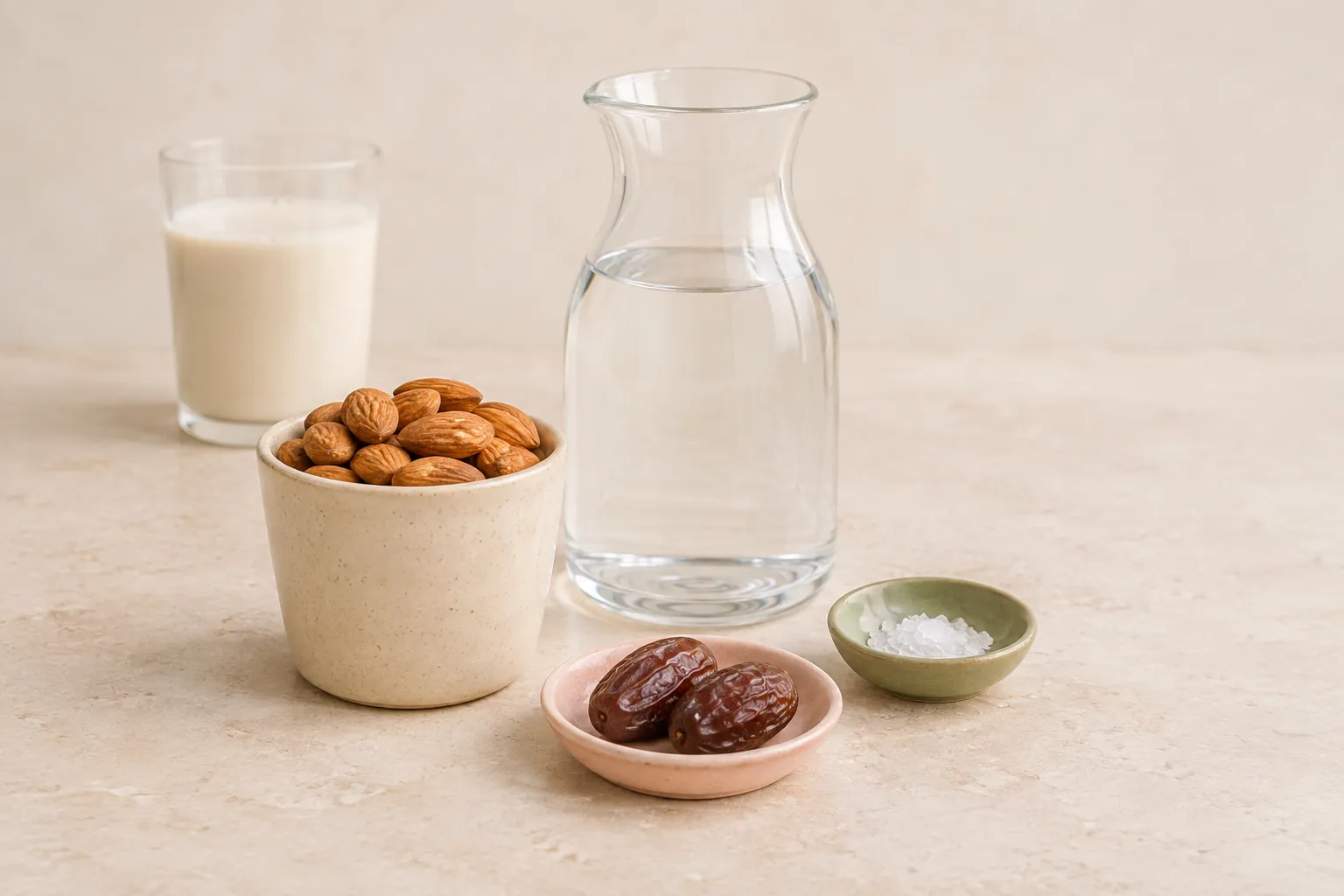
The best ratio for most nut milks is 1 cup (140 g) of nuts to 3 to 4 cups (720 to 960 ml) of water. It works in a milk maker and in a blender alike, and it is a reliable starting point for every nut. From there, adjust the water to match what you will use the milk for.
| What you want | Nuts | Water | Best for |
|---|---|---|---|
| Coffee creamer | 1 cup (140 g) | 2 to 2½ cups (480 to 600 ml) | Coffee, tea, lattes |
| Creamy milk | 1 cup (140 g) | 3 cups (720 ml) | Oats, chia pudding, smoothies, pouring |
| Light drinking milk | 1 cup (140 g) | 4 cups (960 ml) | Drinking by the glass, cooking |
Water is your dial. Once you know where you like it, you can make any nut milk by feel, and most people find their favorite within three or four batches.
A pinch of sea salt is optional. A small pinch brings out the sweetness and the nut flavor a little, the same way it does in baking, but nut milk tastes just as good without it.
Dates are the classic sweetener. One or two pitted Medjool dates per batch add a soft caramel note and their own fiber, and in the Nama M1 they blend fully into the milk. If you prefer it unsweetened, leave them out; almonds, pistachios and macadamias are sweet enough on their own for many people.
One useful habit: write down what you did with each batch for the first few weeks. Nut, water, dates, soak time and how it tasted. Within a month you will have your own perfect ratios, and they will be better than any recipe because they are built around your taste.
Nut Milk Ratios for Every Nut
These are tried and trusted base amounts for each nut, with grams added. Each batch makes about 3 to 4 cups (720 to 960 ml) of milk. They work in a blender too, with the straining step added.
| Milk | Nuts | Water | Also add |
|---|---|---|---|
| Almond | 1 cup (145 g) almonds | 3 cups (720 ml) | 3 dates, pinch of salt |
| Almond and cashew | ⅔ cup (95 g) almonds + ⅓ cup (40 g) cashews | 3 cups (720 ml) | 2 dates, vanilla, cinnamon |
| Pistachio | 1 cup (125 g) shelled pistachios | 3 to 4 cups (720 to 960 ml) | 2 dates, pinch of salt |
| Macadamia | 1 cup (135 g) macadamias + ½ cup (40 g) coconut flakes | 3 to 4 cups (720 to 960 ml) | 2 dates, pinch of salt |
| Hazelnut | 1 cup (135 g) hazelnuts + ½ cup (60 g) cashews | 4 cups (960 ml) | Vanilla, pinch of salt |
| Walnut | 1 cup (100 g) walnuts + ½ cup (40 g) coconut flakes | 3 cups (720 ml) | 3 dates, vanilla, cinnamon |
| Pecan | 1½ cups (150 g) pecans + 2 tbsp pumpkin seeds | 4 cups (960 ml) | 3 dates, warm spices |
| Almond, Brazil nut and cashew | ½ cup (70 g) almonds + 4 Brazil nuts + ¼ cup (30 g) cashews | 3 cups (720 ml) | 1 to 2 dates, vanilla |
Notice a pattern: the harder,
Each milk has its own full guide with variations, coffee notes and flavor ideas: Almond Milk, Cashew Milk, Pistachio Milk, Macadamia Milk, Hazelnut Milk and Walnut Milk.
How to Make Nut Milk in the Nama M1
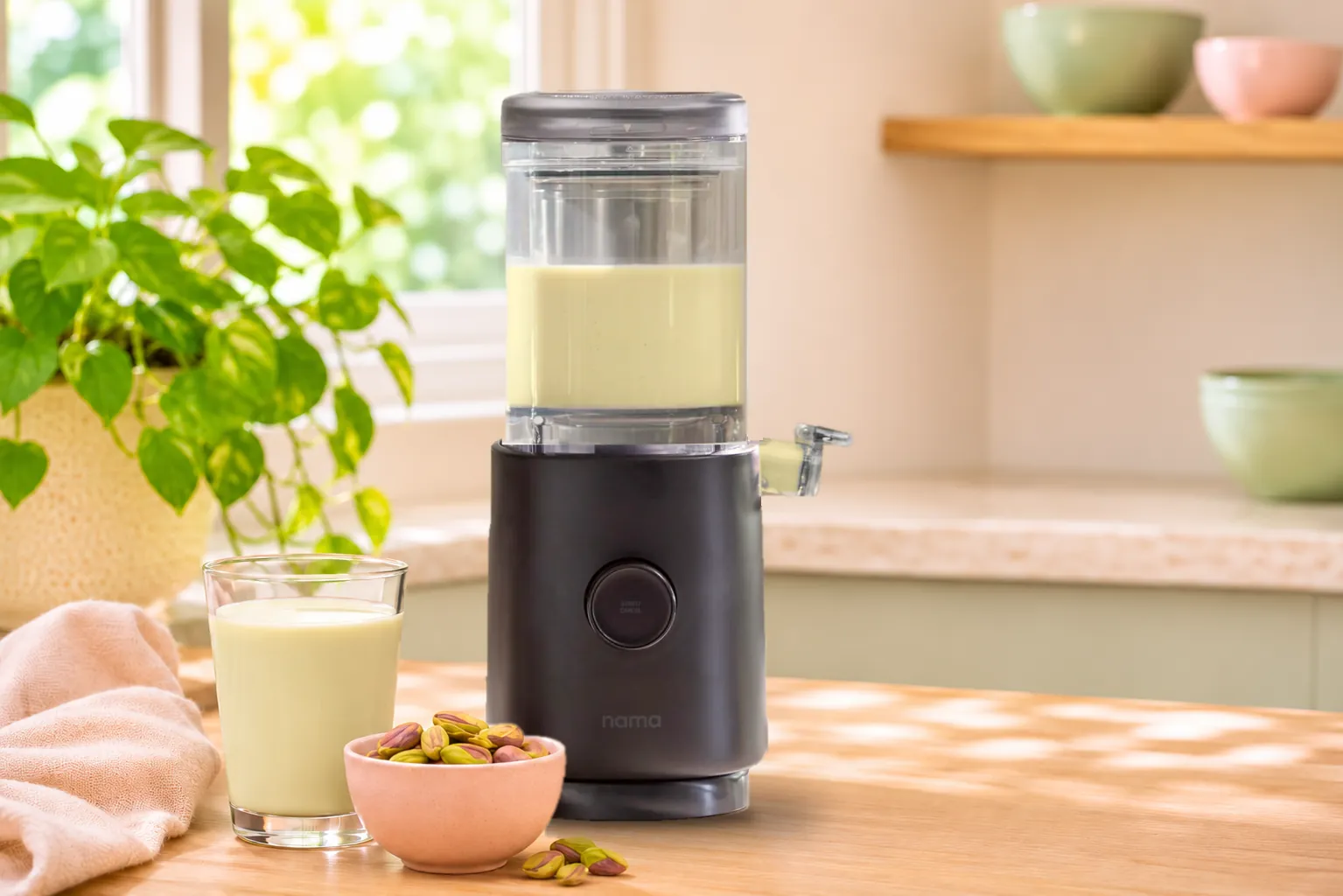
The Nama M1 is a
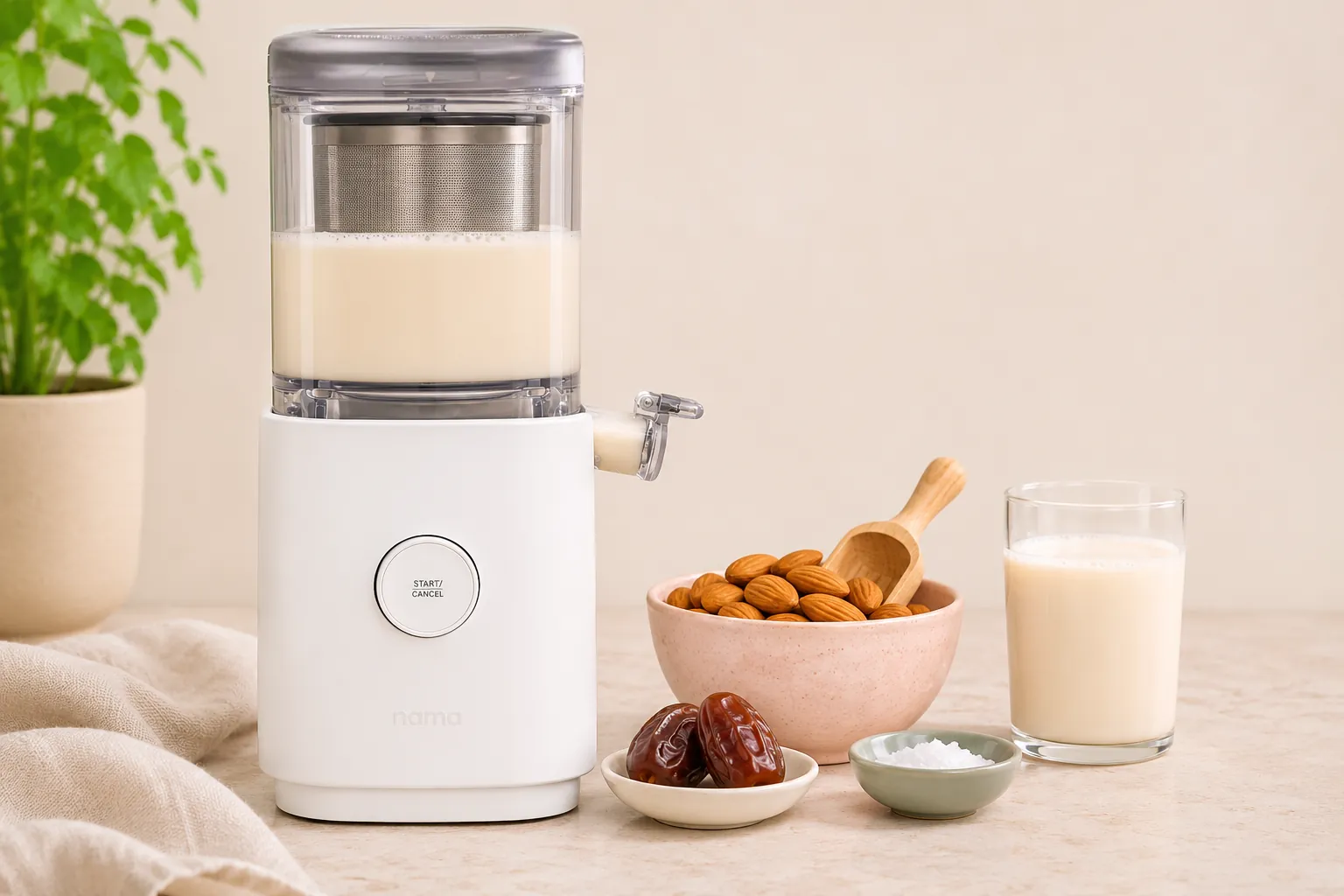
- Check that the spout cap is closed and place the pitcher under the spout.
- Add the nuts, water, dates and salt to the filter basket.
- Secure the lid, set the blending time to 1 minute and press Start.
- When the machine prompts you, open the spout. After 10 seconds the spin cycle starts.
- When the spin cycle stops, close the spout. Your milk is ready.
The pulp stays behind in the filter basket. Lift it out, scrape the pulp into a container for later, and rinse the basket, lid and blade frame under the tap. The whole thing, from bag of nuts to clean machine, fits comfortably into the time it takes to make breakfast.
A few things make the Nama M1 easy to live with day to day. You can set the blending time, so a softer nut like cashew gets a shorter blend and a firmer one gets the full minute. The machine takes nuts straight from the bag, so there is no need to plan ahead with soaking unless you want to. And it works just as well for seeds and oats as for nuts.
It comes in black and in white, with a
How to Make Nut Milk in a Blender
A blender makes beautiful nut milk too. It simply adds one step at the end: straining by hand. Here is how to do it well.
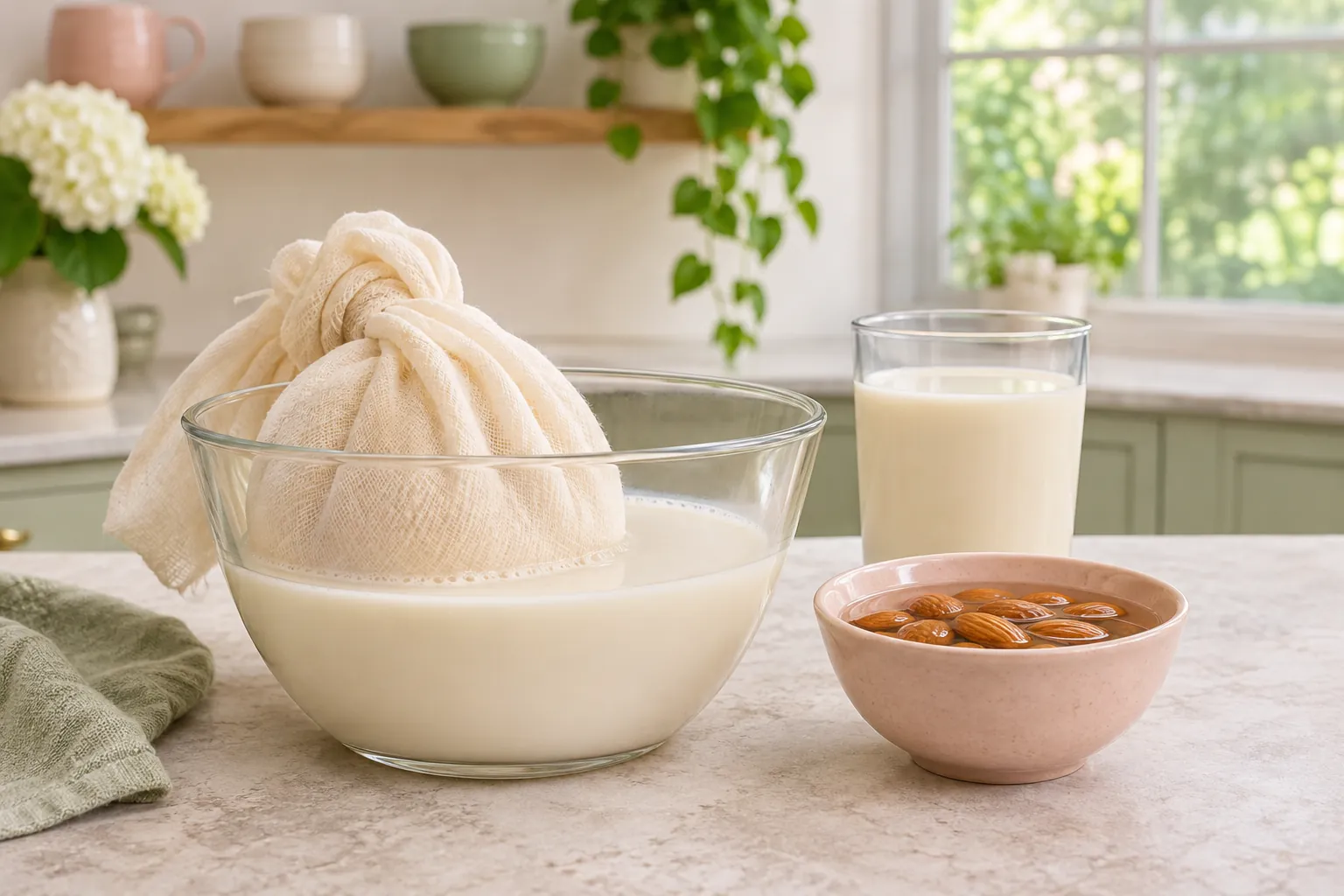
- Add the nuts, water, salt and dates to the blender.
- Blend on high for 60 to 90 seconds, until the water is fully opaque and no pieces of nut are visible.
- Set a nut milk bag over a large bowl or wide jug and pour the milk in.
- Twist the top of the bag closed and squeeze gently from the top down until the pulp feels fairly dry.
- Pour the milk into a glass bottle and chill.
The squeezing is where most of the difference in texture comes from. Squeeze too hard and the finest particles get pushed through the mesh, which gives a slightly chalky milk. Gentle, steady pressure, the way you would wring out a wet cloth, gives the smoothest result.
Rinse the bag right after use while the pulp is still soft: turn it inside out, scrape the pulp into a container, rinse under warm running water and hang it to dry. Once a week, soak it in hot water with a little baking soda to keep it fresh.
No nut milk bag? A fine sieve lined with a thin, clean cotton cloth or a few layers of cheesecloth works well. A sieve on its own lets too much through.
For a regular blender, soaking harder nuts like almonds and hazelnuts first helps a lot. They soften, break down more completely and leave a finer pulp. A
Do You Need to Soak Nuts for Milk?
You do not always need to soak nuts for milk. The Nama M1 handles nuts straight from the bag. In a blender, macadamias blend smooth without soaking; most other nuts, cashews included, give a creamier milk after a soak. Soaking earns its place when you use a regular blender with harder nuts, or when you simply prefer the softer, milder flavor that soaked nuts give.
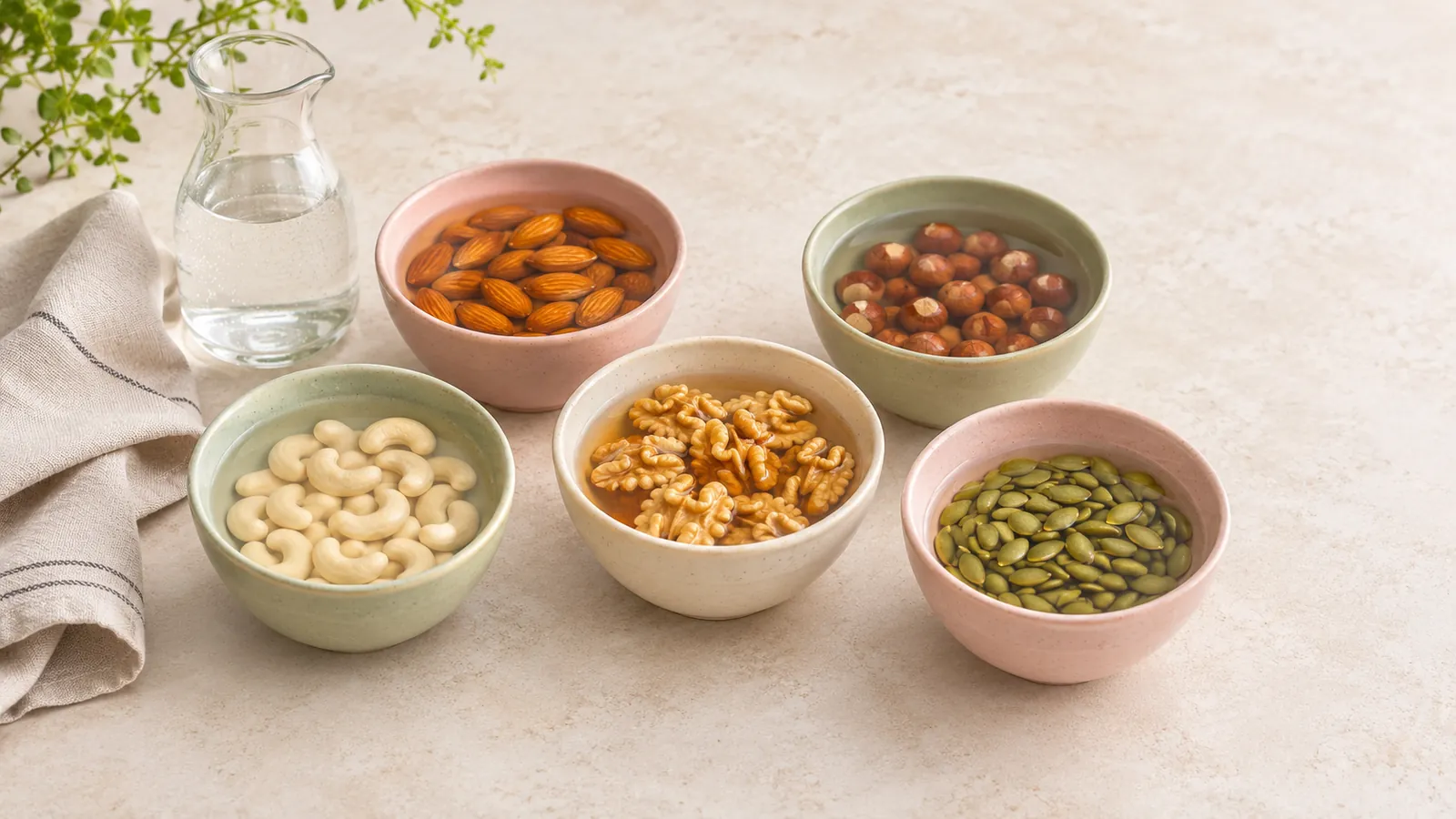
Soaking softens the nut, so it breaks down more completely and blends smoother. It also loosens the skins on almonds and hazelnuts, and it mellows the slightly bitter edge that some nuts have. Walnuts show this clearly: their soaking water turns dark brown as the tannins in the skin, the compounds that give that dry, slightly bitter taste, come out into the water.
| Nut | Soak time | Notes |
|---|---|---|
| Almonds | 8 to 12 hours | Skins slip off easily afterward |
| Hazelnuts | 8 to 12 hours | Milder, less bitter flavor |
| Pistachios | 8 hours | Brighter green, deeper flavor |
| Walnuts | 4 to 8 hours | Discard the dark soaking water |
| Pecans | 4 to 8 hours | Rounder, sweeter taste |
| Cashews | 2 to 4 hours | Longer turns them soft and slimy |
| Macadamias | Optional, up to 2 hours | Creamy straight from the bag |
Three rules make soaking work. First, soak in plenty of cool water, at least twice the volume of the nuts, because they swell. Second, soak in the fridge if you are going longer than a few hours, so nothing starts to ferment. Third, always drain and rinse soaked nuts and use fresh water for the milk; the soaking water has done its job.
The whole topic, including how soaking changes taste and texture and when to skip it, is covered in Soaking Nuts for Milk: When It Helps and When to Skip It.
Find the Exact Soak Time for Any Nut or Seed
The table above covers the nuts on this site. For everything else, including seeds, dried fruit and grains, the free soaking calculator at howlongtosoak.com gives you the exact soak time for each one, plus the time your nuts will be ready if you start soaking now.
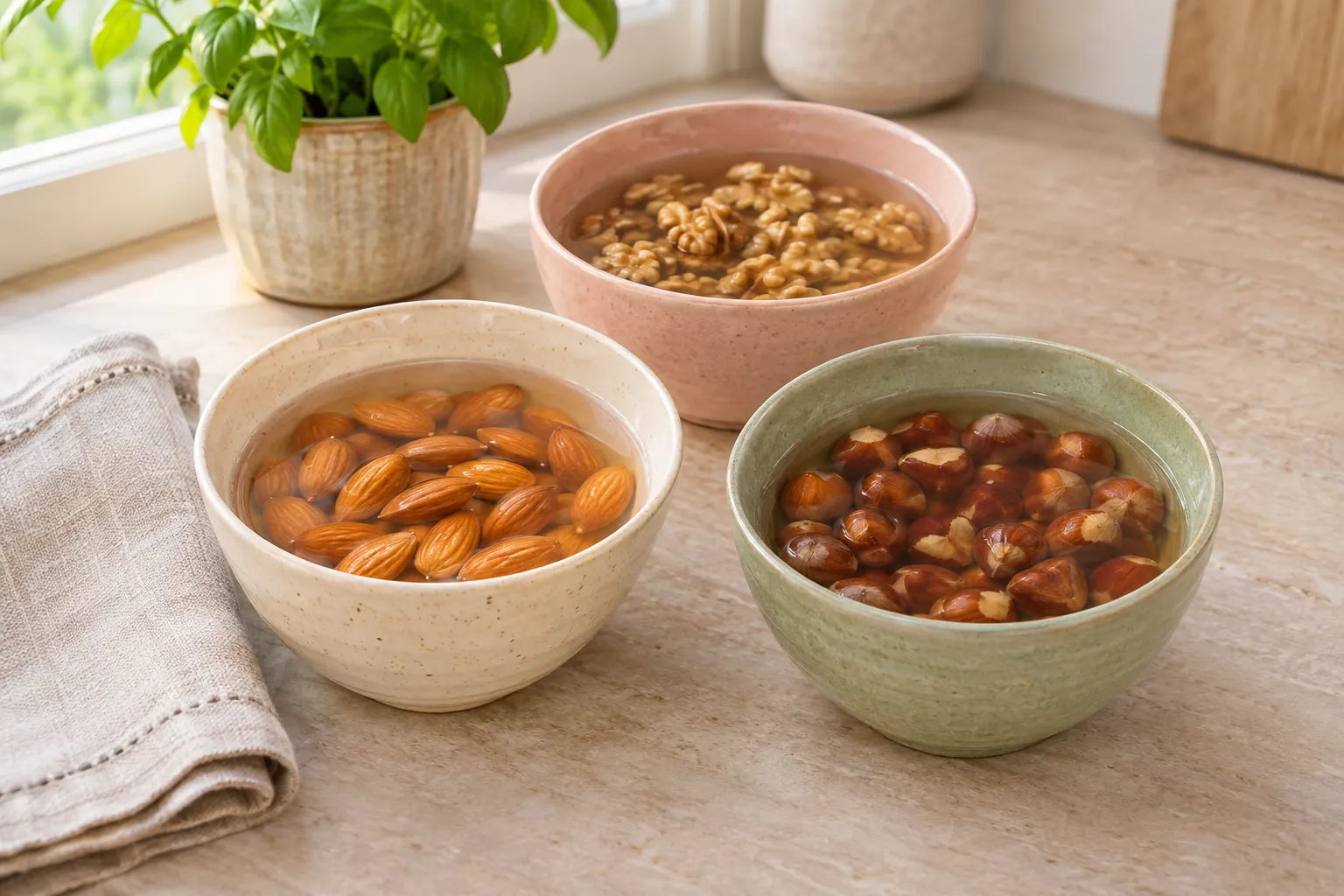
That last part is more useful than it sounds. If you want almond milk for breakfast and the almonds need 8 to 12 hours, you can see at a glance that they should go into water by about 9 the night before. It takes the guesswork out of planning, which is what makes a habit stick.
It also shows you what to do after soaking, ingredient by ingredient: whether to rinse, whether to peel, and how long soaked nuts keep in the fridge if your plans change. It is a small tool, and it makes the whole process feel effortless.
Which Nuts Make the Creamiest Milk?
Cashews and macadamias make the creamiest nut milk. Both are soft, rich in fat and low in skin and fiber, so they break down almost completely and leave very little behind. A cashew or macadamia milk made with 3 cups (720 ml) of water has a body that feels close to cream.
Every nut brings its own character, though, and the creamiest is not always the one you will love most. Here is how each one behaves.
Almond milk is the classic for good reason. It is clean, lightly sweet and versatile, with a little more body from the skins. It works in everything from oats to smoothies, and it is the easiest milk to make taste good every time.
Cashew milk is mild, smooth and almost neutral, which makes it the best base for flavored milks. It takes on vanilla, cacao or spices without competing with them.
Macadamia milk is buttery and rich, with a gentle sweetness. It is the most
Pistachio milk is naturally sweet with a soft savory edge, and it turns a pale, beautiful green. It feels like a treat while being one of the simplest milks to make.
Hazelnut milk tastes the most like dessert, especially with vanilla and a date or two. Pair it with cashews for a silkier finish.
Walnut milk is bolder and slightly earthy, and it shines with cinnamon, dates and coconut. Pecan milk is its sweeter cousin, warm and almost
Can You Make Plant Milk From Seeds and Oats?
Yes, and everything in this guide applies to seeds and oats too. The method is the same: blend, strain, chill. Seed and oat milks are also the answer for anyone who cannot have nuts, or who simply wants more variety through the week.
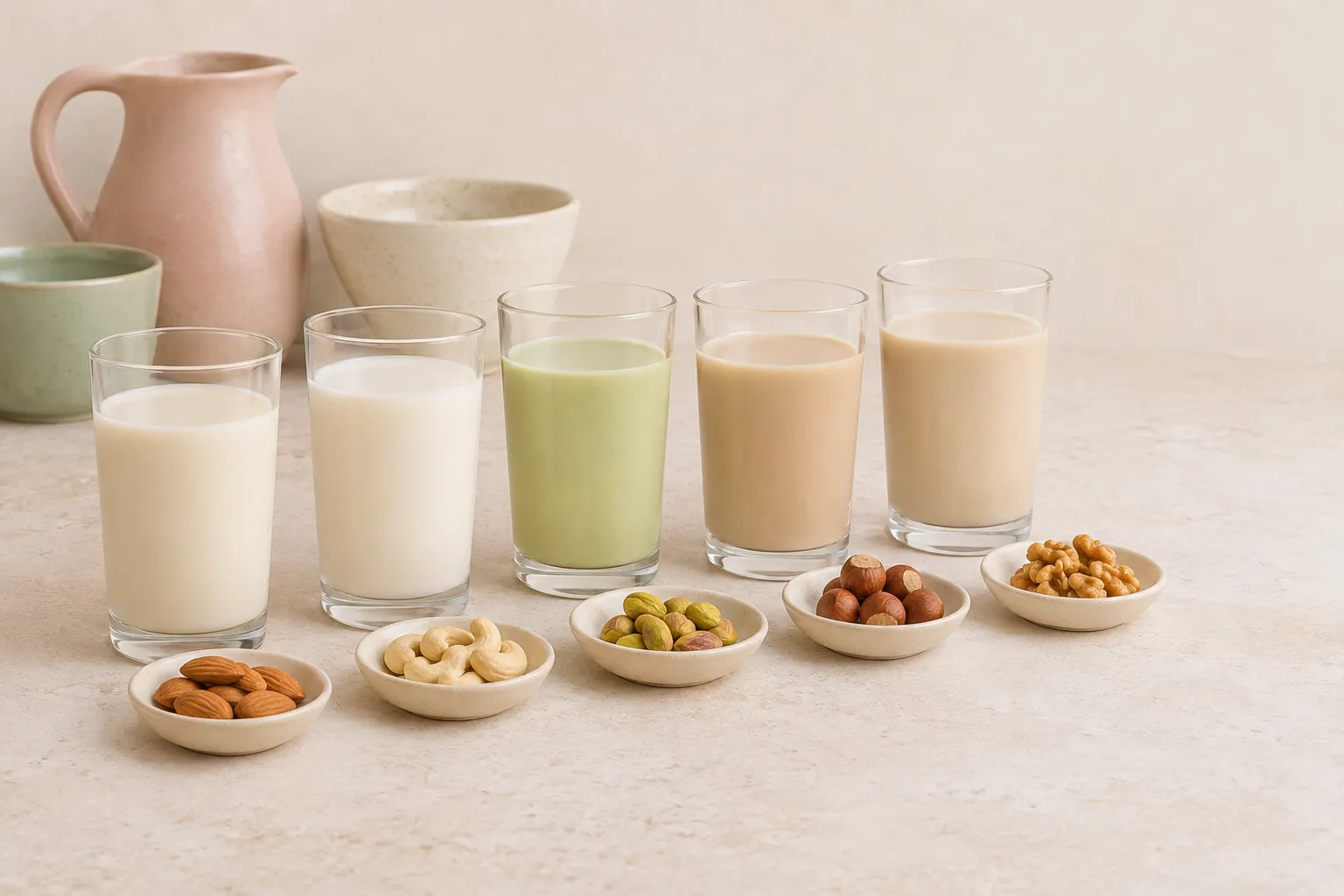
Oats make a soft, naturally sweet milk. A good vanilla cinnamon oat milk uses 1 cup (80 g) of oats with 2½ cups (600 ml) of water, three dates, vanilla, cinnamon and two teaspoons of coconut oil for body. Oats turn slimy when they are blended hot or too long, so use cold water and keep the blend short.
Seeds bring their own character. Hemp seeds make a creamy, grassy milk with no straining needed in a pinch, since hulled hemp seeds break down almost completely. Pumpkin seeds give a pale green, savory milk; ¼ cup (35 g) pumpkin seeds with ½ cup (60 g) cashews gives a rounder flavor. Sesame is bold and nutty, so 2 tablespoons with oats, cashews and cacao is plenty. Sunflower seeds make an affordable, mild everyday milk.
Mixing is where seed milks really shine. Half nuts and half seeds, or half oats and half almonds (½ cup of each with 3 cups (720 ml) of water), gives you a milk with the best of both: the body of the nut and the lightness of the oat or seed. It is also a lovely way to bring more different plants into your week without changing anything else about your mornings.
How to Sweeten and Flavor Nut Milk
Plain nut milk with a pinch of salt is lovely on its own. Flavoring it is where it becomes yours. Add everything to the machine or blender with the nuts and water, so it blends straight in.
Dates are the first choice for sweetness. Medjool dates are soft and
Vanilla is the flavor that makes nut milk taste finished. One teaspoon of pure vanilla extract per batch is enough; a vanilla cashew creamer can take up to a tablespoon for a bolder flavor. Cinnamon is the next most popular, about one teaspoon per batch, and it loves almond, walnut and pecan.
For chocolate milk, add one teaspoon to two tablespoons of raw cacao powder, depending on how deep you want it, with an extra date. Just one teaspoon of cacao with three dates in almond milk gives a soft, milky chocolate.
For a golden milk, add two teaspoons of ground turmeric and half a teaspoon of ground ginger to almond milk, with coconut flakes for body. A pinch of black pepper alongside turmeric is a classic pairing.
Fruit works too. A ripe banana, a handful of strawberries or a few pieces of mango turn nut milk into something closer to a thin smoothie. Make these fresh and drink them the same day, since fruit shortens how long the milk keeps.
How to Make Nut Milk Creamer for Coffee
To make nut milk creamer for coffee, use less water: 1 cup (140 g) of nuts to 2 to 2½ cups (480 to 600 ml) of water. A vanilla cashew creamer, for example, uses 1 cup (120 g) of cashews, 3 dates, vanilla, a pinch of salt and 2½ cups (600 ml) of filtered water.
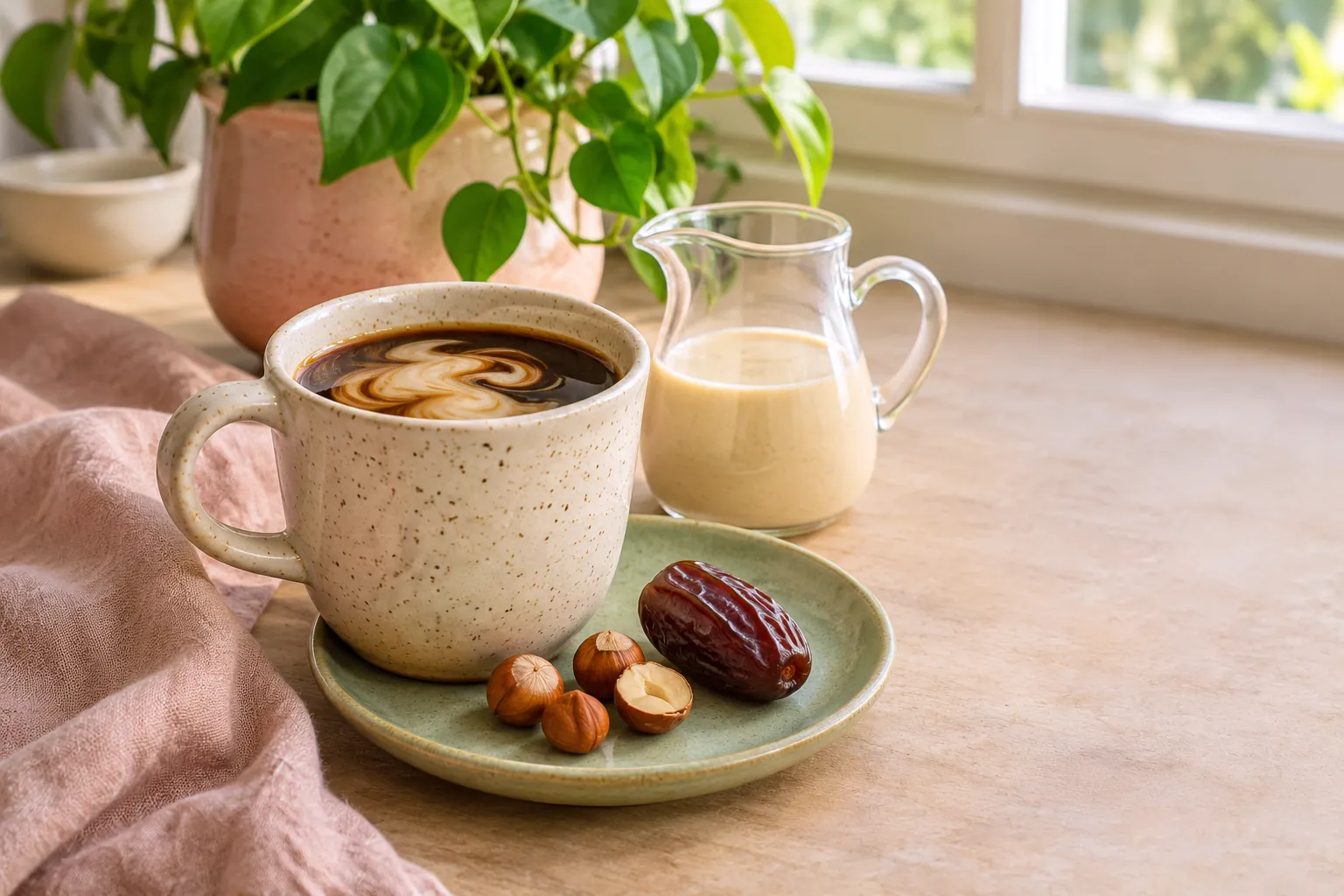
The best nuts for creamer are the rich, soft ones. Cashews give a smooth, neutral creamer that lets the coffee lead. Macadamias give a buttery one. Hazelnuts give that familiar café flavor: a maple hazelnut creamer with ½ cup (70 g) hazelnuts, ¼ cup (35 g) almonds, maple syrup, vanilla and 2 cups (480 ml) of water. Toasted almonds with five dates make a creamer that tastes of caramel.
Homemade creamer behaves a little differently from a carton. It has no added stabilizers, so in very hot or very acidic coffee it can separate into fine flecks. Two simple habits prevent that. Let the coffee cool for a minute before you pour the creamer in, and warm the creamer slightly first, or pour the creamer into the cup first and the coffee on top.
For lattes, warm the milk gently in a milk frother or a small pan over low heat, and stop before it simmers. A richer milk, made with 3 cups (720 ml) of water or less, holds foam better than a thin one.
If coffee is the main reason you make nut milk, the Nama M1 is built for exactly this kind of small, fresh batch. Make a creamer one day and a drinking milk the next, each in about a minute of blending, with the pulp neatly collected for later.
Use discount code PLANTPOWER to save on the
Why Is My Nut Milk Gritty, Thin or Separating?
Almost every nut milk problem has a simple cause, and most are fixed in the next batch.
The first common problem is grit. A gritty or chalky milk means fine particles made it through the strainer. In a blender, blend longer, soak harder nuts first, and squeeze the bag gently rather than hard. If your bag is old, the mesh may have stretched; a new one makes a real difference.
The second is a thin, watery milk. That is almost always the ratio. Go from 4 cups (960 ml) of water to 3 (720 ml), or from 3 to 2½ (600 ml). Adding a soft partner, a few cashews or a little coconut, also gives more body without making the milk taste different.
The third is separation. Homemade nut milk separates in the fridge because it has no emulsifiers, the ingredients that keep fat and water mixed in
The fourth is a bitter taste. Bitterness usually comes from old nuts, from walnut or hazelnut skins, or from not rinsing soaked nuts. Taste a nut before you use it; if it tastes flat or bitter on its own, it will in the milk too. A short soak with a good rinse, a date and a pinch of salt balance the rest.
The fifth is a milk that turns sour quickly. That points to temperature or cleanliness. Keep the milk at the back of the fridge, not in the door, and rinse bottles with boiling water before filling them. Fruit and fresh ingredients shorten shelf life too.
How Long Does Homemade Nut Milk Last?
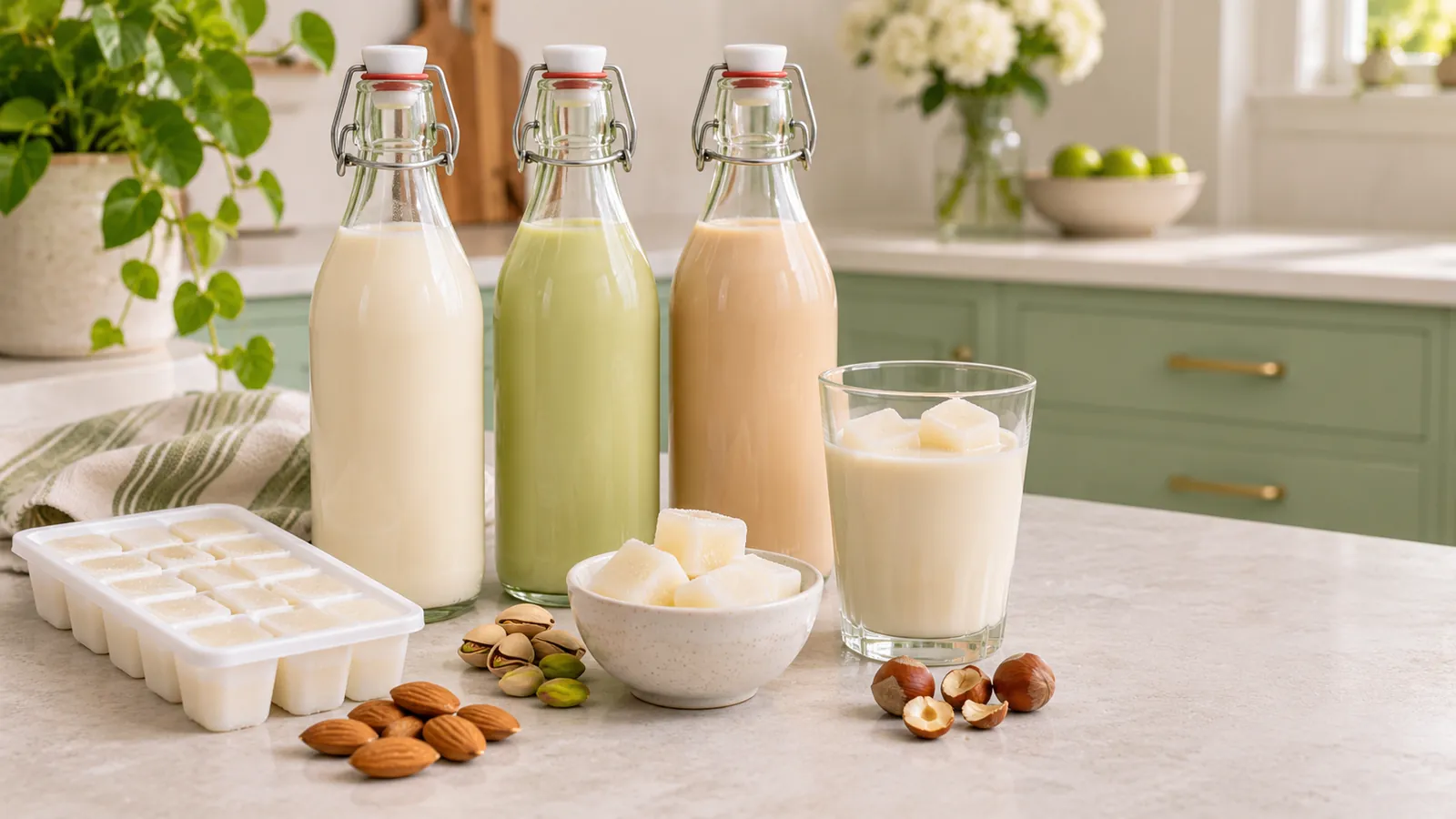
Homemade nut milk lasts up to 3 days in a sealed glass bottle in the fridge. Make it with cold water, bottle it right away and keep it at the back of the fridge, where the temperature stays coldest and steadiest.
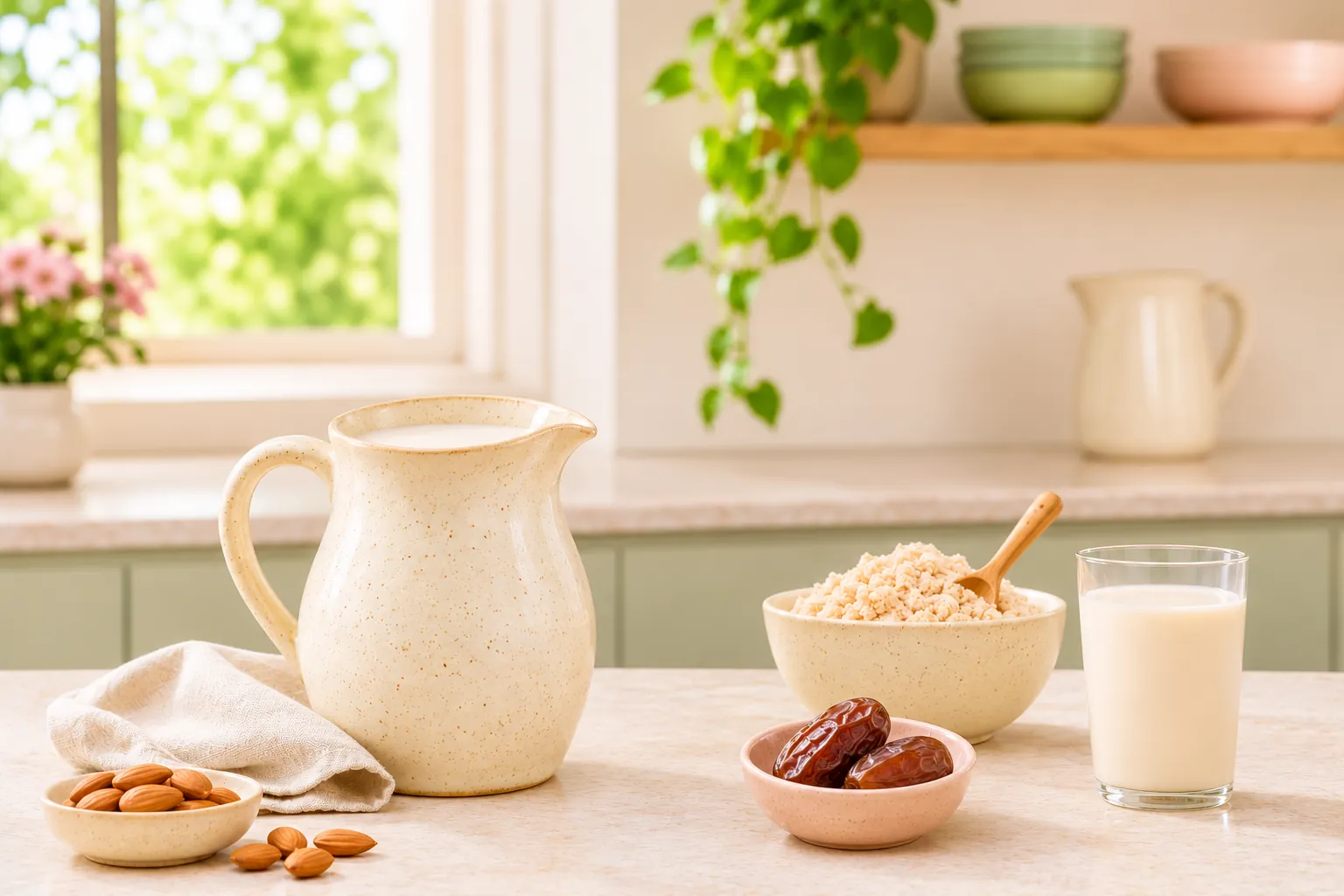
Fresh milk smells sweet and nutty. When it is past its best, the smell turns sour or yeasty and the milk becomes thick, tangy or slightly fizzy. If you notice any of that, it is time for a fresh batch.
Nut milk freezes well for up to a few months, though the texture changes. It separates more after thawing and can look a little grainy. Shake it hard or give it a quick blend and it comes back for smoothies, oats and cooking. Freezing it in ice cube trays is especially handy: a few cubes go straight into a smoothie or an iced coffee.
The easiest way to always have fresh milk is to make smaller batches more often. A
A Simple Week of Homemade Nut Milk
The people who keep making nut milk are the ones who give it a rhythm. It does not need to be complicated. Two or three small batches a week keep the fridge stocked with milk that always tastes fresh.
A rhythm that works for many households looks like this. On the first day, make a creamy almond milk with 3 cups (720 ml) of water for oats, smoothies and cooking. Two days later, make a coffee creamer with cashews or hazelnuts and 2½ cups (600 ml) of water. Later in the week, make something different: pistachio, walnut with cinnamon, or a half oat, half almond milk. Each batch takes a minute of blending and lasts until the next one.
Rotating nuts like this does more than keep things interesting. Each nut brings different fats, minerals and flavors, so a rotation gives you a wider range than any single milk. And every batch adds pulp to the freezer container, ready for crackers or energy bites at the weekend.
If you soak, build it into the evening: nuts into a bowl of water in the fridge before bed, milk in the morning. Within two weeks it stops feeling like a task and starts feeling like part of the kitchen.
Is Homemade Nut Milk Healthy?
Homemade nut milk carries the fats, a fair share of the protein and some of the minerals from the nuts you use, in a fresh, simple form with nothing added that you did not choose. That makes it a wholesome everyday milk, especially when you rotate between nuts.
What passes into the milk is mostly what blends and dissolves: the oils, which give the milk its body and flavor, part of the protein, and minerals like potassium and magnesium. Most of the fiber stays behind in the pulp, which is why the pulp is worth using. Dates are the exception; their soluble fiber blends into the milk, especially in the Nama M1.
Homemade milk differs from fortified cartons in one honest way. Many
The real health strength of homemade nut milk is variety. Rotating almonds, pistachios, walnuts, hazelnuts and seeds through your week gives you a wider range of plant fats and minerals than any single milk could. If blood sugar is your focus, Is Pistachio Milk Good for Diabetes? walks through exactly what a glass carries.
What Can You Do With Nut Milk Pulp?
Every batch leaves you soft pulp, and it is one of the best parts of making your own milk. Nut pulp holds most of the fiber of the nut, along with some of its protein, and it takes on any flavor you give it.
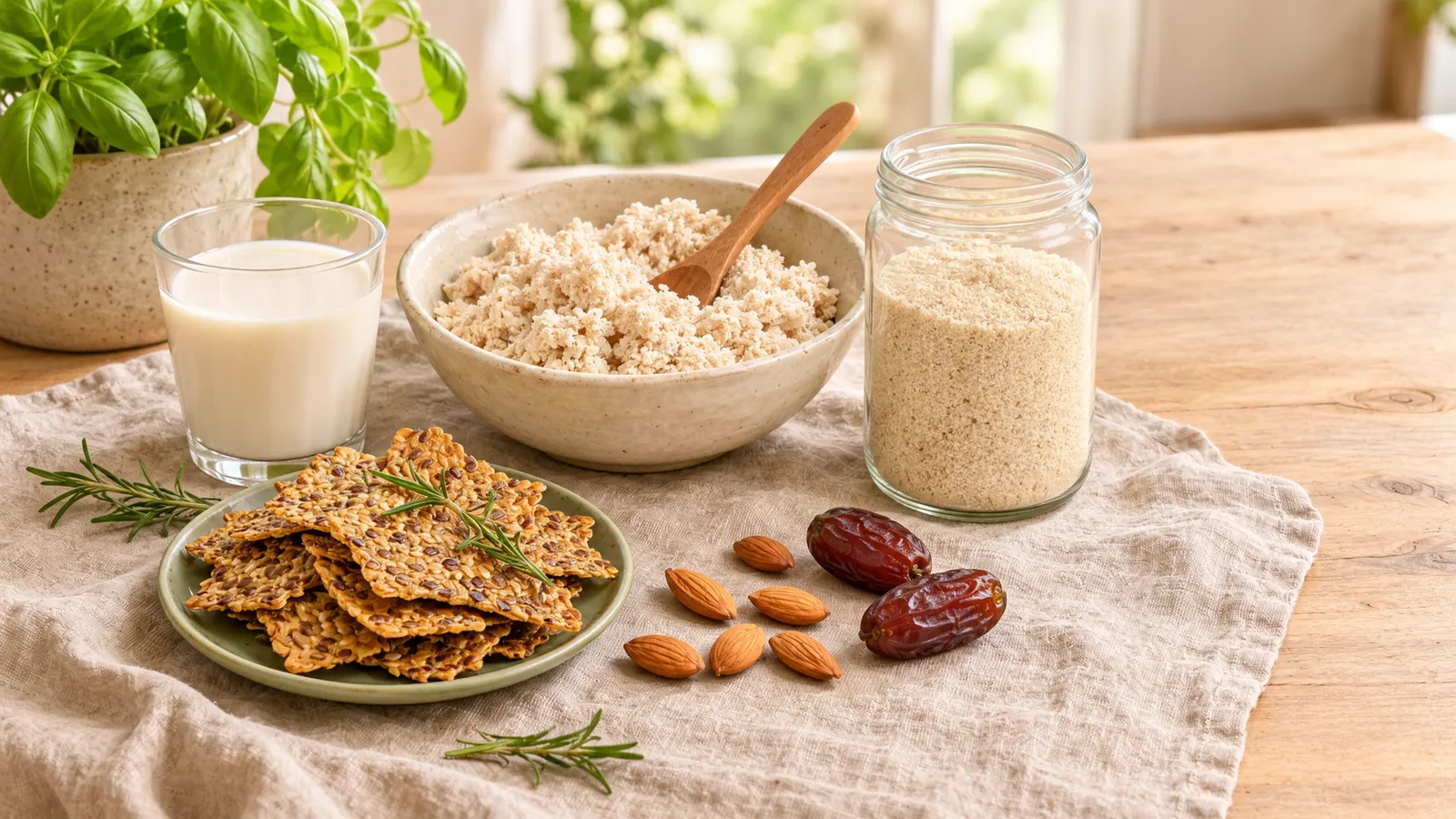
Stir it into oats or chia pudding for extra body. Press it into thin crackers with seeds and herbs and dry them low and slow. Roll it with dates, coconut and cacao into energy bites. Blend it into dips and creamy fillings. Or dry it completely and grind it into a fine flour for baking.
Pistachio pulp is a particular favorite. It is soft, faintly sweet and naturally holds its shape, which makes it perfect for
Pulp keeps 2 to 3 days in a sealed container in the fridge and several months in the freezer. Collect it batch by batch in one freezer container until you have enough for a recipe. The favorite uses, sweet and savory, are in What to Do With Nut Milk Pulp.
Questions People Ask
Do You Need to Add Salt to Nut Milk?
No, salt is optional. A small pinch brings out the sweetness and the nut flavor a little, the same way it does in baking. Nut milk tastes just as good without it, and a date or a little vanilla rounds out the flavor too.
How Much Nut Milk Does 1 Cup of Nuts Make?
About 3 to 4 cups (720 to 960 ml), depending on how much water you use. With 3 cups (720 ml) of water you get roughly 3 cups (720 ml) of milk, since a little stays behind in the pulp.
Can You Make Nut Milk Without a Nut Milk Bag?
Yes. A
Can You Use Roasted Nuts?
Yes, for a deeper, toastier flavor. An almond caramel creamer or a toasted pecan milk uses toasted nuts on purpose. For a classic,
Can You Heat Homemade Nut Milk?
Yes, gently. Warm it over low heat or in a milk frother and stop before it boils, or it can turn grainy and separate.
Why Does My Nut Milk Taste Bland?
Add a pinch of sea salt and one date, or use 3 cups (720 ml) of water instead of 4 (960 ml). Salt and a little sweetness bring out the nut's own flavor.
Is Nut Milk Cheaper to Make at Home?
That depends on the nut and where you buy it. Almonds and cashews bought in bulk are the most economical; pistachios and macadamias cost more. Using the pulp means you get two ingredients from every bag.
Can Kids Drink Homemade Nut Milk?
Yes. Children from about 3 years old usually love it, especially vanilla or strawberry versions, and it adds healthy fats to their smoothies and breakfast bowls. Coconut milk is a lovely one for kids: coconut is rich in lauric acid, a fat that is also found in breast milk. For babies, homemade plant milk does not replace breast milk or formula. For a child with a nut allergy, a seed or coconut milk can be a good option; always check with your pediatrician first.
A cup (140 g) of nuts, a pitcher of cold water, a few minutes of your morning. Make it once, and it quietly becomes part of how your days begin.
Comments
Share your thoughts
A tip, a question or how it went for you: every comment helps the next reader too.
No comments yet. Ask your question or share your thoughts.